Dutching in UK Horse Racing: Covering Multiple Runners for a Fixed Return
 Available in US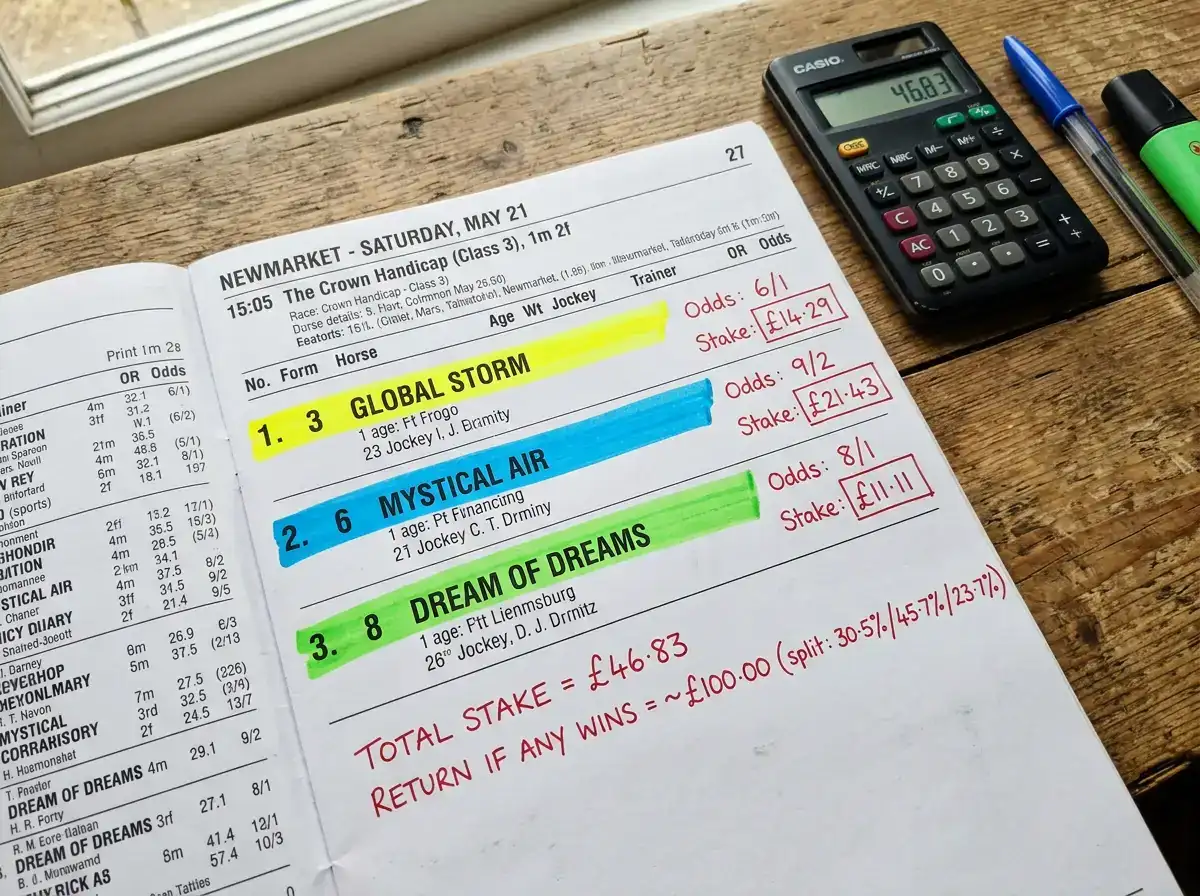
The Bet That Started as a Bookkeeper’s Trick
Dutching is named after Dutch Schultz, the prohibition-era racketeer whose accountant — Otto Berman — figured out that betting two horses for equal returns was sometimes a sounder play than betting one for a bigger payday. The name has stuck for nearly a century, and the maths Berman scribbled on bar napkins is unchanged.
The principle is simple. Instead of staking £20 on one selection, you split the stake across two or three selections in proportions that produce the same profit regardless of which one wins. The total return on a successful race is smaller than backing the winner alone — because you have laid out stake on the others too — but you have multiplied your chances of any return at all. In races where you think one of two or three horses has a real chance but cannot honestly say which, dutching converts a coin-flip-with-extra-coins into a single coherent bet.
The trick is figuring out when dutching beats backing one horse, and that question turns on overround, conviction and field shape. Get those three right and dutching is a clean, mathematical tool. Get them wrong and you are paying a higher rake than necessary for the same loss.
Discover everything about best bet in horse racing here.
How the Stake Split Works
The maths is school-level arithmetic dressed up in betting clothes. Take three horses you want to cover, at decimal prices of 4.0, 6.0 and 10.0. You want to win £30 regardless of which one comes in. You set up the stakes by dividing £30 by the decimal price of each horse minus one — actually a slight simplification, but it captures the intent. For 4.0, that is £30 ÷ 3 = £10. For 6.0, £30 ÷ 5 = £6. For 10.0, £30 ÷ 9 = £3.33. Total outlay: £19.33. If any of the three wins, you collect £30 minus the stakes on the other two losers, netting a profit of around £10.67.
The same arithmetic works in reverse. Pick the total stake you want to commit, and the calculator distributes it across selections so that each produces the same return. Online dutching calculators do this in three seconds. Doing it on paper is also fine if you understand what the numbers represent. What matters is that you have decided in advance: total outlay, target return, selections covered.
Every selection you add to a dutch reduces the per-horse upside but increases the probability of any return. There is a point — usually three to four horses in a typical handicap — beyond which the maths gets ugly because the combined implied probabilities exceed 100% even at market prices, and you are essentially paying overround on a bet you have constructed yourself.
Worked Examples From Real Race Shapes
Take a competitive 16-runner handicap on a Saturday card. The market shows a favourite at 5/2, a second favourite at 7/2, and a third in at 11/2. Three other runners cluster between 9/1 and 14/1, with the rest of the field longer.
You have studied the form and conclude the race is genuinely between the top three in the market. You do not have a strong opinion which of the three will win — your form analysis suggests each has a roughly equal chance. The straight bet would be to back one of the three at the available price and accept a 60–70% chance of losing.
The dutch approach. You commit £40 total, split across the three: roughly £20 on the 5/2 shot, £14 on the 7/2 shot, and £10 on the 11/2 shot. If any of the three wins, you collect about £58 — a profit of £18 on a £44 total outlay. If none of the three wins, you lose the whole £44.
Compare that with the alternative of putting all £44 on one of the three at random. If you happened to pick the winner, your profit would be £110 (£44 × 5/2) for the 5/2 shot, considerably more than £18. But your chance of having picked the right one was one in three. Across many such races, the dutch produces smaller wins more often, while the single bet produces bigger wins less often. The total expected value is roughly equivalent in both cases — minus the small overround drag, which is slightly worse for the dutch because you are paying margin on three selections instead of one.
The dutch wins on variance smoothing, not on expected value. That is the honest case for it: lower variance for similar expected return.
Where Dutching Pays Its Way
Dutching is most useful in two specific race types. The first is large-field handicaps with a tight market top. When eight horses are priced from 4/1 to 10/1 and form-reading genuinely cannot separate two or three of them, dutching captures the conviction you actually have — “one of these three” — instead of forcing you into the false precision of picking exactly one.
The second is novice races over jumps. Novice chases and novice hurdles are notoriously unpredictable because the horses are inexperienced, the form lines are short, and the volatility of who jumps cleanly and who does not is high. Backing two of the three most-fancied novices via a dutch is often a sounder bet than picking one and praying. UK favourites generally win around 30–35% of races, but in novice chases the figure can sit lower while the front three or four in the market collectively still account for most winners.
The festival meetings are where this becomes acute. Cheltenham Festival 2024 saw a 33% favourite strike rate across the four days, including a rare festival favourite winning the Grand National itself. The implication for dutching: across most of the festival, two of three from the top of the market won the race about 60% of the time. That is the kind of arithmetic that supports dutching as a deliberate strategy rather than a hedging panic.
Dutching also works on smaller fields where you have a genuine read on the pace and structure but cannot quite separate two horses. A 7-runner conditions race with two front-runners and five hold-up types often comes down to which of the two leaders gets a softer lead, and dutching the two leaders for equal return captures that without forcing a guess.
Dutching Versus Each-Way
Punters new to dutching often ask whether it is just an expensive way of doing an each-way bet. The answer is no, and the distinction matters.
An each-way bet covers one horse for both win and place outcomes, paying smaller money on the place portion. The place fraction is usually one-fifth or one-quarter of the win odds. You are doubling up on a single horse across two outcomes — win and place.
A dutch covers multiple horses for the win outcome only. Each selection either wins outright or returns nothing on that part of the dutch. There is no place coverage in a standard dutch — the place finish of any of your selections is irrelevant.
The two structures suit different opinions. Each-way is right when you have a single horse you like but are unsure it will quite win, and you want to extract value if it places. Dutching is right when you have two or three horses you cannot separate and you want win-only coverage across them. Mixing the structures — dutching each-way across two selections — is possible but rarely worth the stake outlay, because you are effectively running two each-way bets in parallel and the maths almost always pencils out worse than picking one each-way bet on your preferred runner.
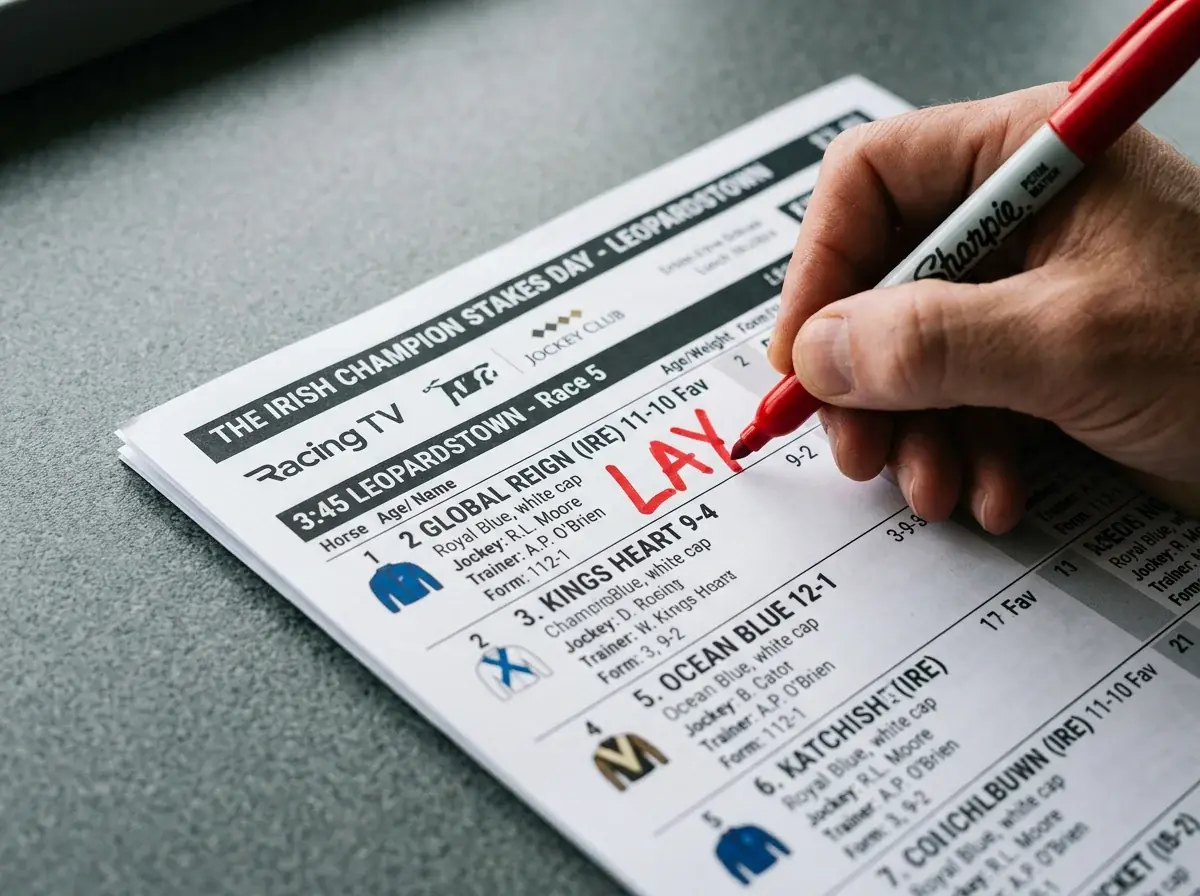
One useful sibling strategy worth understanding alongside dutching is laying horses on the exchange, which approaches the same problem from the opposite direction. Where dutching backs multiple selections to win, laying picks one selection to lose — and in races where you have a strong negative opinion on the favourite, laying can be a cleaner expression of that view than dutching against it.
Risks and the Overround Problem
Dutching has two specific risks that the casual user underrates. The first is the compounding overround. When you dutch three horses at bookmaker prices, you are paying the bookmaker’s margin three times instead of once. A typical UK race book carries 15–25% overround across the full field. The portion of that overround attached to the top three in the market is usually 5–8%. Dutching them all means you absorb the full 5–8% rather than the slice attached to your single pick.
The exchange mitigates this. Betfair Exchange’s commission is 5% of net winnings on each market, and there is no overround stacked into the prices themselves. Dutching on the exchange is meaningfully cheaper than dutching at bookmaker prices, and serious dutchers run almost all their dutches through the exchange for that reason.
The second risk is conviction creep. Punters who use dutching as a hedge often start dutching three horses, then four, then five, telling themselves they are reducing variance. They are not. Beyond about three selections, the combined overround eats most of the expected value, and you are essentially paying the bookmaker for permission to not pick a winner. The discipline rule: dutch two or three selections only, and only when your form analysis genuinely cannot separate them. If you can pick one with conviction, dutching is the wrong tool.
The Honest Place of Dutching in a Punter’s Toolkit
Dutching is not a magic strategy. It is variance management, applied at the bet level. Used selectively in the two or three races a month where your form-reading produces a genuine “one of these” conclusion, it improves your hit rate without dramatically degrading your long-run return. Used promiscuously as a way to feel like you are spreading risk, it costs you the overround multiplied by your stake on every dutched race.
Check out our guide on Each-Way Betting on Horse Racing: When the Place Pays You as well.
The punters I respect who use dutching well share two habits. They dutch on the exchange wherever liquidity permits, capturing the cleaner price structure. And they keep a separate record of their dutched bets versus their single bets, because the variance profiles are different and treating them as a single P&L line hides which approach is actually working. Pull those two habits into your own routine and dutching becomes a useful piece of equipment rather than a comfort blanket.
How many horses can I dutch in one race?
Technically as many as you like — the maths works for any number. Practically, two or three selections is the sweet spot. Beyond three, the combined overround at bookmaker prices eats most of the expected value, and you are paying margin on each selection without proportionally reducing your loss probability. Even on the exchange, where overround is minimal, dutching four or more horses usually signals that you do not have a strong opinion in the first place — in which case skipping the race is the cheaper decision.
Is dutching better than backing the favourite?
Sometimes, sometimes not. Dutching beats backing the favourite when your form analysis identifies two or three horses with similar credible chances and you cannot honestly say which is most likely. It loses to backing the favourite when one selection clearly stands out — in which case dutching just dilutes your edge. The decision rule is conviction: a single strong opinion is best expressed as a single bet, while a ‘one of these’ opinion is best expressed as a dutch. Treat the choice as a function of how confident you actually are, not a default strategy.
Prepared by the Best bet in Horse Racing editorial staff.