
Flat Racing vs National Hunt Betting: Two Sports, Two Strategies
 Available in US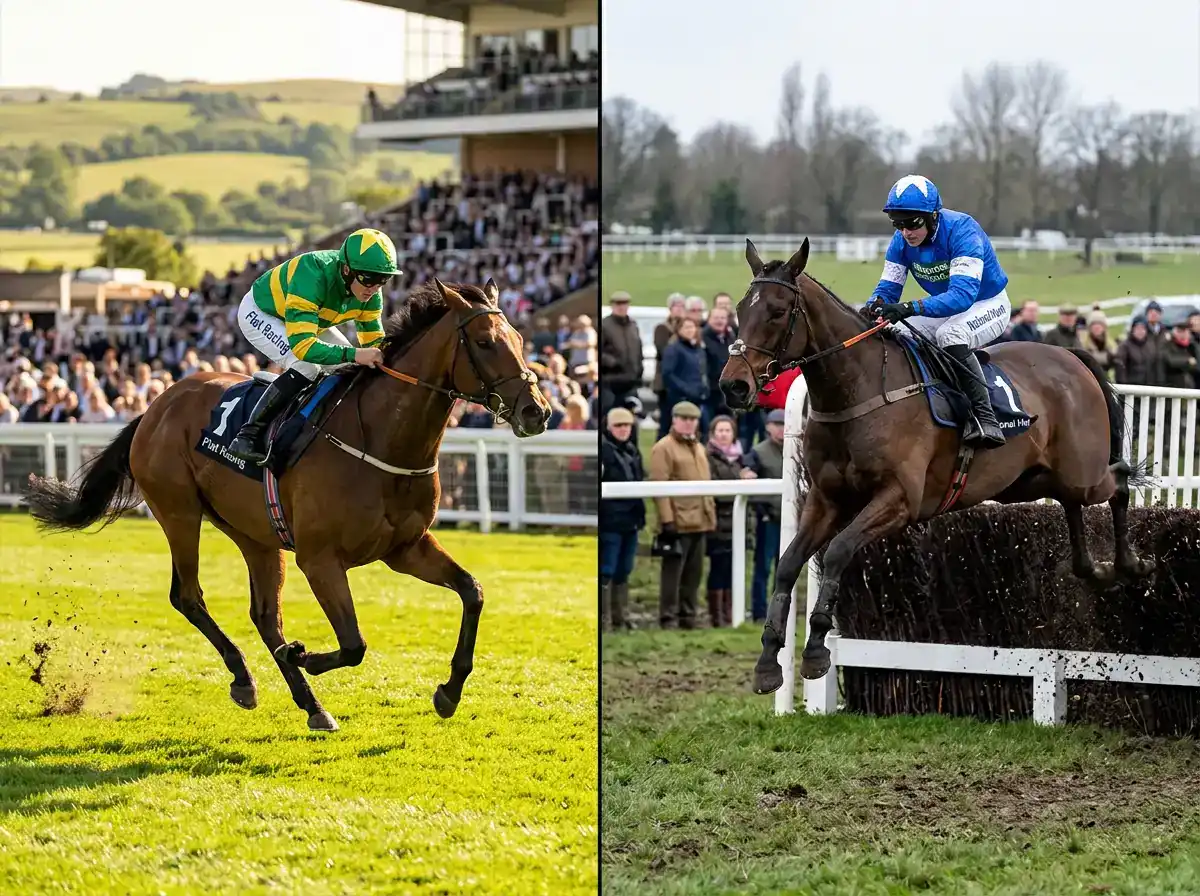
Table of Contents
- The Day I Bet Both Codes Wrong
- Two Codes, Two Rulebooks
- When the Racing Calendar Reshapes Your Betting Year
- Why National Hunt Form Sticks and Flat Form Lies
- Field Size, Margins and the Overround Gap
- Handicap Puzzles: The Three-Year-Old Problem on the Flat
- Festivals That Move the Market
- Matching Your Bet Type to the Code
- Splitting Your Bankroll Across Twelve Months
- Your Questions About Flat and National Hunt Betting
- The Punter Who Works Both Sides of the Calendar
The Day I Bet Both Codes Wrong
October 2019 taught me a lesson I should have learned years earlier. On a Saturday where the flat season was winding down at Newmarket and the jumps card at Wetherby was heating up, I applied the same analytical framework to both. I backed a flat handicapper stepping up in trip because his pedigree suggested stamina. He finished sixth. I backed a novice hurdler at short odds because his bumper form looked strong. He fell at the second. Two losers from two codes, both failures of the same mistake — treating flat and National Hunt as variations on a theme when they are, for betting purposes, entirely different sports.
The surfaces are different, the distances are different, the age profiles of the horses are different, and the way the market prices them is different. A punter who approaches both codes with a single strategy is doing something akin to using football analysis to bet on rugby because both sports involve a ball and a pitch. The overlap is superficial. The profit comes from understanding the divergence.
Over nine years of analysing UK racing markets, I have built separate systems for flat and jumps — different form models, different staking rules, different seasonal rhythms. This article walks through those differences and explains where each code offers opportunities that the other does not.
Find the best options for best bet in horse racing.
Two Codes, Two Rulebooks
Start with the basics, because even experienced punters muddle them. Flat racing takes place on level ground with no obstacles. Distances range from five furlongs (roughly 1,000 metres) to two miles and six furlongs, with the majority of races falling between six furlongs and a mile and a half. Horses compete from age two upward, with two-year-olds exclusively racing on the flat. The turf season runs roughly from March to November, though all-weather flat racing continues year-round on artificial surfaces at venues like Lingfield, Wolverhampton, Kempton and Chelmsford.
National Hunt racing — often called “jumps” — involves obstacles. There are two types: hurdles (smaller, more forgiving) and fences or steeplechases (larger, more demanding, including open ditches and water jumps). Distances start at about two miles and stretch beyond four miles for the most extreme tests. NH horses are generally older, typically aged four and above, because younger horses lack the physical maturity to jump safely under race conditions. The core NH season runs from October to April, peaking at the Cheltenham Festival in March and the Grand National meeting at Aintree in April.
Surface matters enormously. Flat racing takes place on turf or all-weather (polytrack, tapeta, or fibresand). NH racing is overwhelmingly run on turf, meaning going conditions — the firmness or softness of the ground — play a larger role throughout the jumps season, which coincides with the wettest months of the British calendar. A horse’s going preference can be the single most important factor in a jumps race, far more so than on the flat where artificial surfaces remove that variable entirely.
The weight system differs too. Both codes use handicaps, but NH races also feature conditions chases and graded races where the weight structure is more fixed. The claiming system and apprentice allowances function similarly in principle, but the practical impact of a 3lb claim is different when a horse is jumping thirty birch fences over three miles compared to sprinting five furlongs on a flat track.
When the Racing Calendar Reshapes Your Betting Year
I used to go quiet during the winter. No flat racing worth watching, I told myself, so I would take three months off and come back in April. That was before I realised the jumps season is where some of my best annual returns were hiding — and before I understood that the all-weather circuit fills the gap between the two codes with its own set of opportunities.
The flat turf season begins in earnest at the Guineas meeting in late April and builds through Royal Ascot in June, the July meeting at Newmarket, Glorious Goodwood, and the York Ebor festival in August. The quality tail drifts through September and October before Champions Day at Ascot closes the top-tier programme in mid-October. The all-weather continues beyond that, running through winter at venues where all-weather form operates by different rules than turf — different biases, different pace dynamics, different draw effects.
The NH season overlaps significantly. The early jumps meetings at Chepstow, Carlisle and Cheltenham in October transition into a packed winter programme, with the Christmas fixtures (Kempton’s King George, Leopardstown) serving as major form trials for the spring festivals. Cheltenham in March and Aintree in April represent the zenith. After that, NH racing scales back, though scattered summer jumps cards continue at smaller meetings.
This seasonality creates a measurable pattern in the betting public. Gambling Commission survey data shows 7% of UK adults placed a bet on horse racing in the April-to-July period of 2025, climbing from 4% during the January-to-April window. By the July-to-October period, participation had dropped back to 4% — a seasonal dip that corresponds to the flat season’s tail and the gap before the jumps calendar ramps up. That cycle of public engagement affects market liquidity. During peak periods, more money flows into the market, the bookmaker overround tightens, and prices become more efficient. During quieter periods — early jumps season, midweek all-weather — less public money means less efficient markets and more potential value.
A punter who only bets one code is leaving those quieter, less-efficient windows on the table. The optimal approach is not to specialise exclusively in flat or jumps but to understand when each code offers the best risk-to-reward conditions and shift your attention accordingly.
Why National Hunt Form Sticks and Flat Form Lies
In my third year of serious punting, I noticed something that should have been obvious from the start: my strike rate on jumps races was consistently 3-4% higher than on the flat, even though I was using the same form-analysis method for both. The explanation, once I dug into it, was straightforward — NH form is inherently more stable, and stable form is easier to analyse accurately.
The age profile explains most of this. National Hunt horses are mature athletes. A seven-year-old chaser has likely had twenty or thirty career starts, all extensively documented. You can see how the horse handles soft ground, right-handed tracks, two-and-a-half mile trips, and Grade 2 company. The form book is deep. Patterns emerge. A horse that runs well fresh after a break will keep doing so. A horse that hates heavy ground at three miles will still hate it at eight years old. These preferences are stable because the horse’s physical characteristics — stride length, jumping technique, stamina ceiling — do not change dramatically once the horse has matured.
Flat racing is different. Two-year-olds have no form at all before their first run. Three-year-olds might have two or three starts to their name, all on different ground and at different distances. The physical improvement curve is steep — a three-year-old in April can be a fundamentally different horse by September, having strengthened, learned to settle, or simply matured into a longer trip. This makes flat form inherently less reliable. You are not just assessing what the horse has done; you are predicting how much it has improved since it last ran, and that prediction is essentially a guess dressed up in expertise.
For the punter, this has a direct consequence. NH racing rewards patient form analysis. You can build a form picture over months and seasons, tracking how a horse performs under specific conditions, and that picture retains its accuracy because the variables change slowly. Flat racing rewards speed of assessment and a willingness to trust incomplete information. The three-year-old that won a maiden at Nottingham in April might be a Group horse by August, but you need to identify that potential trajectory before the market does — and the market is very good at pricing potential.
The practical upshot: if you are a methodical, data-driven bettor who likes to build detailed profiles and track patterns over time, NH racing will suit your strengths. If you are comfortable with uncertainty, fast-moving markets, and making judgements on thin evidence, the flat offers more opportunities for outsized returns — at the cost of a lower baseline accuracy.
Field Size, Margins and the Overround Gap
A ten-runner race and a five-runner race are not just different sizes — they are fundamentally different betting propositions. The number of runners shapes every aspect of the market: the overround, the place terms on each-way bets, the probability distribution, and the margin of error in the bookmaker’s pricing.
BHA data from the 2025 Racing Report shows the average field size across flat races was 8.90 runners, down slightly from 9.14 in 2024. Jumps races averaged 7.84 runners, a sharper drop from 8.49 the previous year. The gap between the two codes — roughly one full runner per race — is consistent and structural, not a one-year anomaly. Flat racing, with its larger population of eligible horses and more stratified conditions, naturally produces bigger fields.
The distinction sharpens at the top end. Premier flat fixtures averaged 11.02 runners per race in 2025, a number that stretches well above the overall flat average and is significantly higher than anything the jumps programme produces. Large-field Premier handicaps with sixteen or more runners are a regular feature of the summer flat calendar. In NH racing, a field of sixteen runners is rare outside of the Grand National and a handful of festival handicap hurdles.
Why this matters for betting: the bookmaker overround is roughly proportional to field size. More runners mean a wider aggregate market, which means a higher total overround in percentage terms, but a lower overround per horse. In a five-runner race, the market might sum to 115% — a 15% margin distributed across five horses, each carrying roughly 3 percentage points of margin. In a sixteen-runner race, the market might sum to 135%, but each horse carries just over 2 percentage points. The individual runner is actually more fairly priced in the bigger field, even though the total overround is higher.
For each-way bettors, field size is even more critical. Place terms only activate at five runners or more, and the fraction (1/4 or 1/5 of the odds) and number of places paid depend directly on the field size and race type. A handicap with sixteen or more runners pays four places at 1/4 odds. An eight-runner non-handicap pays two places at 1/4 odds. The larger flat fields create more each-way opportunities with more generous terms, which is one reason the each-way bet is more naturally aligned with flat handicap betting than with jumps racing.
Smaller NH fields also mean the favourite wins more often, simply because there are fewer opponents to beat. A 7/4 favourite in a six-runner novice chase has structurally better chances than a 7/4 favourite in a twelve-runner flat handicap, even if the implied probability is identical. The market accounts for this to some degree, but the efficiency of pricing in small NH fields is higher — meaning the value, on average, is thinner.
Handicap Puzzles: The Three-Year-Old Problem on the Flat
If I had to name the single most frustrating category of race to bet on, it would be three-year-old flat handicaps between July and October. The horses are improving at unpredictable rates, the handicapper is working with limited data, and the trainers are deliberately managing their ratings by placing horses in races designed to keep the official mark low until a big target arrives. It is a game within a game, and the punter is usually the last person to understand the game plan.
Here is the problem in concrete terms. A three-year-old wins a maiden in May off a mark of 75. The handicapper assesses the performance and gives it a rating of 80. The trainer then runs the horse in a couple of races at 80-82, where it finishes mid-division without being asked a serious question. The mark might drop to 78. Then, in September, at a big meeting with a valuable handicap, the trainer unleashes the horse with a first-time visor, a strong jockey booking, and a fitness programme timed to peak on that specific day. The horse wins by three lengths at 14/1. The punter who backed the favourite, a well-exposed four-year-old rated 90, wonders what happened.
What happened is that the three-year-old was never properly exposed. Its true ability was always above 78, but the campaign was managed to prevent the handicapper from seeing the full picture. This is not cheating — it is standard training strategy, and every major flat yard practises some version of it. The point is that it makes flat handicaps, particularly those limited to or including three-year-olds, deeply unpredictable. The form book tells you what the horse has done; it does not tell you what the horse has been allowed to do.
NH handicaps are different. The horses are older, their abilities are more established, and the scope for rapid improvement is narrower. A seven-year-old chaser rated 135 is unlikely to suddenly become a 150-rated horse overnight. Improvement over jumps tends to be gradual — a horse learning to jump more efficiently, adapting to softer ground, or benefiting from a step up in trip. These improvements are visible in the form if you know where to look. The flat’s three-year-old mystery factor does not exist in jumps racing in the same way.
The practical consequence is that NH handicaps are, on average, more formful — meaning the form book is a more reliable predictor of the outcome. Favourites in NH handicaps have a marginally higher strike rate than in flat handicaps, not because the horses are better but because the form is more transparent. For the punter, this means NH handicaps are a slightly more forgiving environment for systematic form analysis, while flat handicaps require an additional layer of pattern recognition around trainer intent and campaign management.
Festivals That Move the Market
The BHA figures frame the scale neatly: the racing industry generates direct revenues exceeding £1.47 billion annually, with a total economic contribution to the UK of £4.1 billion when induced effects are included. A substantial chunk of that economic activity concentrates around the major festivals, which serve as both the sport’s commercial engine and the betting market’s most liquid — and most distorted — events.
Take the Grand National. The race generates an estimated £60 million for the Liverpool City Region economy each year. It draws 9-10 million television viewers, most of whom bet on no other race all year. That wave of casual money floods the market with uninformed opinion, pushing favourites to artificially short prices and creating pockets of value on overlooked runners. A forty-runner handicap chase over four and a quarter miles is already the most complex betting puzzle in British racing; add several million once-a-year punters and the distortions multiply.
Royal Ascot plays a similar role on the flat side. Five million viewers watched on ITV in 2025, with viewership on the final day rising by 20%. The meeting features the highest concentration of Group 1 races on the UK flat calendar, and the Royal Hunt Cup, Wokingham and Britannia handicaps attract enormous each-way interest. The difference from the Grand National is the type of casual money: Ascot’s television audience tends to be slightly more racing-literate, which means the market distortions are smaller but still present, particularly in the big handicaps where volume swamps analysis.
Cheltenham Festival is the NH equivalent of both. The favourite strike rate at the 2024 Cheltenham Festival was around 33%, which is roughly in line with the overall UK average but feels low given the calibre of horses. Cheltenham compresses the best NH talent into four days, meaning fields are stronger, exposed form is deeper, and the public’s attachment to big names inflates short-priced favourites beyond their true probability. The value at Cheltenham often sits in the second or third tier of the market — the 8/1 to 20/1 range where quality horses with solid form are overshadowed by the obvious narrative picks.
Glorious Goodwood and the Ebor meeting at York complete the flat’s festival calendar. Both feature valuable flat handicaps with large fields, and both attract enough mainstream attention to create mild market inefficiencies. The Stewards’ Cup at Goodwood — a six-furlong sprint handicap with a notoriously strong draw bias — is one of the most formbook-resistant races on the calendar and a personal favourite for each-way speculation.
Matching Your Bet Type to the Code
Not every bet type works equally well across both codes, and understanding the fit is one of the quickest ways to improve your return without changing your selection method at all.
Each-way betting is structurally better suited to flat racing. The larger average field sizes mean better place terms, more places paid, and a wider distribution of outcomes. A twelve-runner flat handicap paying three places at 1/4 odds gives your place stake a much higher expected value than a six-runner novice chase paying two places. That is not to say each-way never works over jumps — big-field NH handicap hurdles at festivals are excellent each-way races — but as a default strategy across a season, each-way delivers more on the flat.
Win-only betting is the cleaner proposition over jumps, particularly in conditions races and graded events. With smaller fields and more transparent form, the task is simpler: identify the most likely winner and take the price. The shorter-priced horses in these races offer less value on the place part of an each-way bet anyway, because two places from six runners means you need to be in the top third — not substantially easier than winning.
Accumulators are a mug’s bet in both codes, but they are a particularly expensive mug’s bet on the flat. The variance introduced by lightly-raced improvers, draw biases, and three-year-old handicappers means that even a well-researched four-fold on the flat carries a compounded error rate that renders the selection process almost academic. If you must bet accumulators — and I would argue you should not — NH conditions races with short fields are the least destructive option, because the form is more stable and the outcomes are more predictable.
One angle I have found consistently productive is NH novice hurdles for value-oriented win betting. Novice hurdlers are, by definition, running in the early stages of their careers over obstacles, but many have extensive bumper (flat NH race) or Irish point-to-point form that UK markets sometimes underweight. A horse that won a Wexford point-to-point by fifteen lengths and is now making its British hurdles debut at Musselburgh might be genuinely mispriced at 12/1 if the market is focused on the lack of UK form. This is a niche, but it has been one of my most reliable sources of long-odds winners over the past five years.
Splitting Your Bankroll Across Twelve Months
I learned this the hard way. In my early years, I ran a single bankroll for all racing. When the flat season ended in November, whatever was left sat idle for three months until I came back in the spring. That idle capital was earning nothing, and I was missing an entire code’s worth of opportunities.
The approach I use now is simpler than it sounds. I run one bankroll — not two — but I allocate my weekly betting budget differently depending on the time of year. From March to October, when the flat turf season is in full flow and the NH programme is lighter, roughly 70% of my weekly allocation goes to flat races and 30% to any jumps races that qualify under my system. From November to February, those proportions invert: 70% to NH and 30% to all-weather flat. During the crossover months — October and March — I split closer to 50/50 and let the day’s card determine where the qualifying bets fall.
This is not rigid. Some weeks produce no qualifying bets on the flat and five over jumps, regardless of the calendar allocation. The percentage split is a guide for attention, not a hard cap on betting volume. The underlying principle is to invest your analytical effort where the current opportunity is richest. During the peak flat season, the sheer volume of competitive handicap racing — eight or nine meetings on a Saturday, many with twelve-plus runners — provides the largest opportunity set. During the winter, the NH programme is the richer source, and the smaller all-weather cards offer niche spots that repay careful study.
The staking rules do not change between codes. One to two percent of bankroll per bet, regardless of whether the race is a Listed hurdle at Cheltenham or a Class 5 handicap at Wolverhampton. The code is not a risk indicator — a value bet is a value bet, and the Kelly fraction does not care whether the horse is jumping fences or racing on polytrack. What changes is the volume of qualifying bets, not the size of the stakes.
Your Questions About Flat and National Hunt Betting
Is it easier to make money on flat racing or jumps?
Neither code is inherently easier. Flat racing offers larger fields and more each-way opportunities, but form is less stable due to lightly-raced improvers and three-year-old handicappers. National Hunt form is more reliable because the horses are older and their abilities are better established, which suits systematic form analysis. The most profitable approach is to bet both codes and adjust your focus seasonally — flat from March to October, jumps from November to April, with all-weather filling the gaps.
How does the smaller average field size in NH affect favourite betting?
NH races average 7.84 runners compared to 8.90 on the flat. Smaller fields mean fewer opponents for the favourite to beat, which contributes to a slightly higher strike rate for NH favourites in conditions races. However, smaller fields also produce more efficient markets — less room for the bookmaker to hide margin across many runners — so the value on favourites is often thinner. The each-way proposition is weaker in small NH fields because fewer places are paid and the place fractions are less generous.
Should beginners start with flat or National Hunt betting?
National Hunt racing is more forgiving for beginners because form patterns are more stable and the smaller field sizes make analysis less overwhelming. A six-runner novice chase is easier to assess than a sixteen-runner flat handicap. That said, the flat season runs during better weather, the race coverage is more accessible, and the all-weather provides a consistent year-round schedule. Starting with NH conditions races and small-field flat races builds confidence before tackling the complexity of big-field handicaps.
The Punter Who Works Both Sides of the Calendar
After nine years of betting both codes, I am convinced that the punter who treats flat and NH as separate disciplines within a single framework has a structural advantage over the specialist who ignores half the calendar. The specialist knows one code deeply, and that depth has real value. But depth alone does not compensate for three or four months of forced inactivity when the season ends, or for the missed opportunities in a code you have written off as “not my thing.”
Read our detailed review of Grand National Betting Guide: Strategy for UK’s Biggest Race.
The differences between flat and jumps — form stability, field size, handicap dynamics, seasonal liquidity — are not obstacles to overcome. They are the entire point. Each difference creates a specific set of conditions under which certain bet types, certain analysis methods, and certain market inefficiencies become productive. Matching your approach to the conditions is the job, and the punter who can do that across twelve months, across both codes, is the one who compounds returns when others are sitting on the sideline waiting for their season to come back around.
Created by the ”Best bet in Horse Racing” editorial team.