All-Weather Horse Racing Betting: A Year-Round UK Edge
 Available in US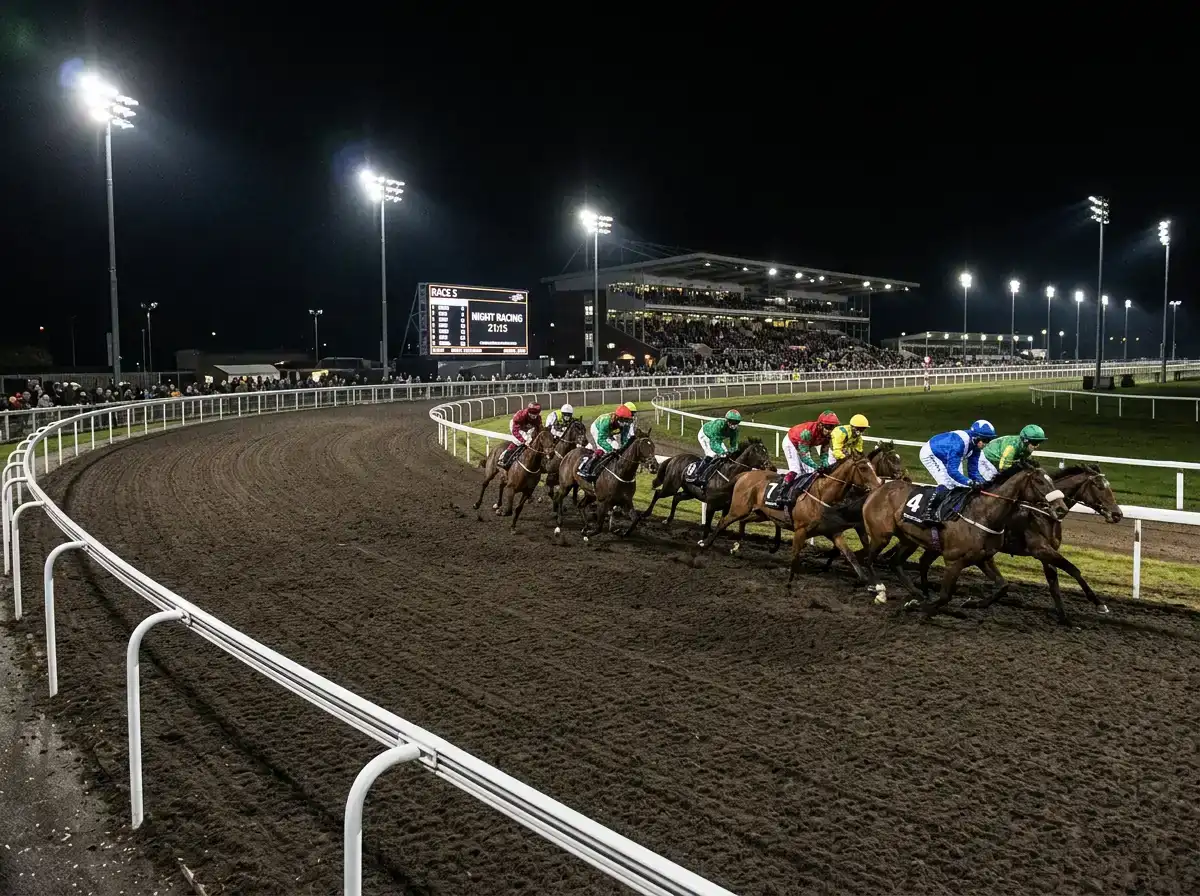
The Surface That Most Punters Ignore
I spent a January Wednesday a few years ago at Wolverhampton with a friend who could not understand why I was there. “It’s all-weather,” he said, as if that ended the conversation. He was at Cheltenham trials that week, paying full attention to soft ground at proper jumps. My all-weather card produced two winners and a placed each-way. His Cheltenham afternoon produced a long lunch and a small loss.
That mismatch in attention is the all-weather edge. The UK’s six synthetic courses run racing year-round, including through the depths of winter when turf racing is constrained by weather. The form lines on these surfaces are more stable than on turf, draw biases more consistent, and surface variation between meetings much smaller. The professional punters know all this. The casual punters, in my friend’s tradition, dismiss the all-weather as a sideshow. The gap between the two attitudes is one of the most reliable structural edges in UK racing.
Discover everything about best bet in horse racing here.
The Six UK All-Weather Courses
The UK all-weather circuit operates across six courses, each running on a synthetic surface chosen to provide consistent racing year-round. The courses split into two surface camps based on the synthetic material used.
Lingfield, Kempton and Chelmsford race on polytrack — a surface composed of silica sand, rubber and synthetic fibres bound with wax. Polytrack drains quickly, produces predictable times across the meeting, and rides slightly faster than turf in equivalent conditions. The track at Lingfield in particular has shown the highest favourite win rate in UK racing across recent reporting at around 50%, partly reflecting the stability of the polytrack surface combined with the course’s tight configuration that favours predictable racing patterns.
Newcastle, Southwell and Wolverhampton race on tapeta — a different synthetic composition with a coarser feel and slightly different riding characteristics. Tapeta runs a touch slower than polytrack in equivalent conditions and produces sharper draw effects on certain configurations. Each course within the tapeta group has its own character — Newcastle’s straight mile, Southwell’s tight bends, Wolverhampton’s mixed-distance card — but the underlying surface behaviour is more consistent within the tapeta camp than between the two camps.
The six courses operate on a shared calendar that runs from October through March intensively and at lower volume during the summer turf season. The major target meetings are the All-Weather Championships Finals Day at Lingfield in March and various series qualifiers across the winter, which concentrate punter interest into specific weeks of the season.
The 2025 racing-in-training count of 21,728 UK horses — down 2.3% on 2024 — distributes across both codes and surfaces. The implication is a slightly smaller pool of all-weather specialists than in previous years, which intensifies the value when those specialists target races that suit them.
Polytrack Versus Tapeta in Practice
The two surfaces ride differently enough that form lines do not transfer cleanly between them. A horse who has won three times on polytrack at Lingfield is not automatically a candidate to win on tapeta at Newcastle, and vice versa. Trainers know this and target horses at the surface that suits them best.
Polytrack tends to favour horses with good early speed and clean travelling action. The surface’s faster ride rewards horses who can settle close to the pace and quicken when needed, while horses requiring deeper ground to produce their best often appear ordinary on polytrack. The surface also produces more consistent times across multiple meetings at the same course, which makes time-based analysis more reliable than on turf.
Tapeta has a slightly more demanding feel and tends to favour stamina-orientated horses and those with strong galloping actions. Stamina markers in pedigree show up more reliably on tapeta than on polytrack, and horses who handle softer turf often transfer their form to tapeta more cleanly than to polytrack. The surface’s slightly slower ride also creates more opportunities for closers, particularly in larger fields where the early pace is genuinely committed.
The cross-surface form transfer is one of the recurring analytical challenges. Some horses run well on both polytrack and tapeta; many do not. Identifying which is which from previous race results, rather than assuming transfer, is the discipline that separates serious all-weather punters from casual ones. The 2025/26 fixtures saw National Trainers Federation chief expressing concern about the industry’s broader trajectory: “Today’s budget sees us live to fight another day, but the sport has work to do, alongside Government, if we are to create a more prosperous future.” Inside that financial uncertainty, the all-weather circuit remains one of the more stable revenue producers for many UK trainers, which means specialist all-weather yards continue to invest in horses suited to the synthetic surfaces.
What the Lingfield Data Tells Us
Lingfield’s 50% favourite win rate across recent reporting is the highest of any UK course, and it represents one of the cleanest statistical signals in UK racing. The figure does not mean Lingfield favourites are mispriced — it means the market correctly identifies favourites in races where the underlying conditions favour predictable outcomes.
The mechanism. Lingfield’s polytrack runs consistently from meeting to meeting. The course’s configuration — a tight, near-circular shape — favours horses with early speed and consistent travelling action. The draw effects are stable enough that the market prices them reliably. The combination of stable surface, predictable race shape and well-priced markets produces races where favourites translate market confidence into actual wins more reliably than at most other UK courses.
The implication for the punter is not that backing every Lingfield favourite is a profitable strategy — the market has already priced the higher win rate into the odds, which is why Lingfield favourites trade at shorter prices than equivalent horses at other courses. The implication is that Lingfield is a course where form analysis works well, where the surface does not introduce random variance, and where the disciplined punter can apply clean form-reading methods without the noise that turf racing often introduces.
Where value at Lingfield lives is usually in the second tier of the market — horses priced 5/1 to 10/1 with credible chances who get overlooked because the favourite is so frequently the focus of attention. The casual money piles into the favourites; the disciplined punter looks one level down and finds the price gaps where the structural stability of the course is producing genuine winning chances at value odds.
The other courses do not produce the same favourite-friendly figures. Wolverhampton and Southwell in particular show more variance in favourite performance, partly because their tapeta surfaces and course configurations introduce more race-shape variability. The takeaway is that Lingfield is a specific case rather than a universal all-weather pattern.
How Turf Form Translates
The single biggest question in all-weather betting is how form lines from turf transfer to synthetic surfaces and vice versa. The answer is: partially, with specific horses transferring well and others not at all.
Turf-to-all-weather transfer is most reliable when the horse’s turf form was produced on slower ground. Soft and good-to-soft turf form transfers reasonably to both polytrack and tapeta, because the underlying demand on the horse — produce sustained effort on a demanding surface — is similar. Firm-ground turf form transfers less reliably, because the horse’s edge on firm ground is often a finishing-pace advantage that the synthetic surfaces do not amplify in the same way.
All-weather-to-turf transfer is similarly mixed. Horses whose best form is on polytrack often run respectably on good-to-firm turf, where the surface is faster and the demands on travelling action are similar. Horses whose best form is on tapeta often transfer better to softer turf, where the stamina-oriented demands match.
The horses worth tracking are those that have proven they handle both turf and synthetic. The all-weather circuit is the natural development ground for many trainers’ second-string horses, and those who acquire form on both surfaces over time become predictable performers regardless of where they race next. These horses are usually priced fairly when running on either surface, with the analytical work concentrated on identifying the new transitions rather than the established performers.
The bookmaker market is generally well-informed about surface transfer, but it lags in pricing specific individual transitions. A horse making their first synthetic-surface start after several wins on soft turf may be priced as if their transition is a mystery, when in fact the form profile clearly supports the transfer. These individual mispricings are where careful surface-aware form analysis produces edge — usually two or three races per month rather than a daily volume of opportunities.
Finals Day and the Bonus Series
The All-Weather Championships Finals Day at Lingfield in March is the punctuation mark on the winter all-weather season. The day features seven championship races across different distance and age categories, each carrying substantial prize money funded partly by the championship series qualifiers run across the winter. The meeting attracts above-average field sizes and pulls in the strongest all-weather horses of the season.
The strategic dynamic is unusual. Horses who have been campaigned across the winter targeting Finals Day are at peak fitness for the day, while horses appearing first time on synthetic for that meeting are usually outclassed. The form analysis for Finals Day favours horses with established all-weather records and proven series performance, and rewards punters who have followed the championship trail since October.
Bookmaker promotions on Finals Day tend to be generous. Extra-place offers, BOG-eligible early prices, and enhanced acca bonuses are routinely available across the major UK books. The promotional environment converts a meeting that would otherwise be a moderately competitive event into one where the structural punter edge from promotions stacks meaningfully on top of form-based selection.
Outside Finals Day, the regular winter all-weather card produces consistent value for selective punters. The smaller fields, stable surfaces, and predictable race shapes mean the analytical work pays off more reliably than on turf, particularly during the dead-of-winter weeks when much of the betting market’s attention is elsewhere. The combination produces some of the best risk-adjusted returns available in the UK calendar for punters willing to engage with synthetic-surface racing.
One adjacent angle that complements all-weather analysis is identifying horses whose recent losses underrate their actual ability — the same beaten-favourite pattern that produces edge on turf often appears more cleanly on all-weather because the surface variance is lower. The complete approach is in UK racing’s most tested angle on beaten favourites, where the all-weather circuit serves as one of the cleaner testing grounds for the system because the form lines remain stable enough to identify genuine next-time-out improvers.
The Quiet Edge of the Synthetic Calendar
All-weather racing is the UK calendar’s quietest source of consistent edge for the punter willing to engage with it. The form is more stable. The surfaces are more predictable. The market is less crowded than equivalent turf meetings. The promotional environment is generous. And the casual money continues to ignore the synthetic surfaces in favour of weekend turf cards even during the winter months when turf options are limited.
Check out our guide on Ante-Post Betting on UK Horse Racing: Risk, Reward and Non-Runner Rules as well.
Used as part of a year-round betting approach, all-weather racing provides the analytical platform that turf racing struggles to match in winter. The punters who treat it as a sideshow miss the point. The punters who treat it as the predictable, surface-stable circuit it actually is find themselves with a quieter, less glamorous but materially more reliable source of long-term return than the weekend cards they once thought were the only racing worth following.
Does turf form translate to all-weather?
Partially, depending on the horse and the surface. Form from soft and good-to-soft turf transfers reasonably to both polytrack and tapeta because the underlying demand on the horse — produce sustained effort on a demanding surface — is similar. Firm-ground turf form transfers less reliably because the horse’s edge on firm ground is often a finishing-pace advantage that synthetic surfaces do not amplify. The horses worth tracking are those who have produced form on both surfaces over time and become predictable performers regardless of where they race next. New transitions from turf to synthetic should be evaluated cautiously, with attention to the specific surface and the horse’s running style rather than blanket assumptions about transfer.
Which all-weather course favours hold-up horses?
Tapeta courses — particularly Newcastle and Wolverhampton — generally produce more opportunities for closers than polytrack courses. The slightly slower ride of tapeta and the larger field sizes in some of these meetings create races where committed early pace exhausts the leaders and leaves room for hold-up horses to run through the field in the closing stages. Polytrack courses like Lingfield favour horses with early speed and clean travelling action because the surface’s faster ride and tight course configurations reward horses settling close to the pace. The mapping is not absolute — race-specific factors like field size and pace setup still matter — but as a general pattern, the tapeta camp suits closers more reliably.
Published by the Best bet in Horse Racing team.