Horse Racing Accumulator Tips: When Multi-Bets Are a Smart Bet
 Available in US
The Bet Type Built on a Marketing Promise
The most damaging idea in UK punting is that accumulators are how small bankrolls become big ones. Every Saturday in every pub from Truro to Tynemouth, someone is telling someone else about the £5 acca that paid £870 last weekend. Nobody ever mentions the previous twenty Saturdays where the same person’s £5 came back as nothing.
I do not have a moral problem with accumulators. The maths is what it is. What I have a problem with is the framing that treats them as a route to outsized returns rather than what they actually are: a tool for raising variance. Sometimes raising variance is what you want. Most of the time, for most punters, it is not. The trick is knowing when an acca is the smart bet on the slip, and when it is the bet that turns a winning afternoon into a losing one through sheer compounded probability.
Find the best options for best bet in horse racing.
How Accumulators Actually Work
An accumulator combines multiple selections into a single bet, where each selection must win for the bet to pay out. The odds of the individual selections multiply together, producing a final price that looks dramatic but reflects the maths exactly.
Take four horses priced at 5/2, 3/1, 4/1 and 7/1 — decimal 3.5, 4.0, 5.0 and 8.0. Multiply them: 3.5 × 4.0 × 5.0 × 8.0 = 560. A £5 four-fold accumulator would return £2,800 if all four win. That number is what catches the eye. What rarely gets calculated is the implied probability of all four winning, which is the inverse of the multiplied odds: 1/560, or roughly 0.18%. Less than one in 500.
The market thinks each of those horses wins at the implied rate of its own price — 28%, 25%, 20% and 12.5% respectively. If the market is correct and the events are independent, the combined probability of all four winning is 28% × 25% × 20% × 12.5% = 0.175%. The bookmaker offering 560/1 — actually 559/1 in the example — is offering a price that essentially matches the true probability, minus the standard race-by-race overround compounded across four races.
Therein lies the structural problem. Every race has an overround. Standard UK race-day overround is 15–25% across the full field. When you multiply four races together, you are multiplying four overrounds together too. The bookmaker margin compounds, even though no individual selection looks especially overpriced. This is the multiplied-margin problem, and it is the single most important piece of arithmetic in understanding accumulators.
Doubles and Trebles: Where the Maths Is Less Punishing
Two- and three-leg accumulators — doubles and trebles — sit in a different statistical space from the larger multis. A double on two selections at 3.0 each pays 9.0, with a combined implied probability around 33% × 33% = 11%, against a fair-price probability for a 9.0 shot of 11.1%. The overround compounds, but only twice, so the bite is manageable.
Doubles and trebles are the structures where accumulators can sometimes earn their keep. The reason is that on a card where you have two genuinely strong opinions — not “leaning toward” but “high-conviction selections” — a double captures the combined value of those opinions without the punishing compounded-margin drag of larger multis.
The discipline. A double should be two selections you would back as singles anyway. The acca framing of “if I link them, I get a bigger return” is true, but the bigger return reflects bigger risk, not bonus value. A double pays more than two singles only because both have to come in. Treat it as a single coherent bet on two conditions, not as a way to multiply your winnings.
Trebles work the same way. Three high-conviction selections, with combined odds that produce a return commensurate with the combined risk. Beyond three legs, the maths starts breaking down rapidly. A four-fold at typical UK race prices already requires a near-miraculous combination of outcomes to pay out, and the margin drag is meaningful enough that the expected value across a sample of similar bets is decisively negative.
The Multiplied-Margin Problem
This is worth dwelling on because most casual punters do not see it. Each race in an accumulator carries its own bookmaker margin. Each margin is small — maybe 5% on the top of the market in a competitive handicap. Across two races, the compounded margin is roughly 5% + 5% + a small interaction term = around 10%. Across four races, around 22%. Across six races, around 35%. Across an eight-fold? Around 50%.
What this means in plain English: an eight-fold accumulator at standard UK race-day prices is effectively betting at 1.5x the fair price across the combined selections. The bookmaker has built half of your stake into their margin before any of your horses runs. Even if your eight selections are individually fair-priced, the multi has a negative expected value of around 33% of stake. You need your selections to be substantially undervalued by the market to overcome that compounded drag.
The exchange softens this, because the back-lay spread is much tighter than the bookmaker overround, but most punters never construct accumulators on the exchange because the workflow is not designed for it and the lay-side liquidity does not always support the multi structure. The realistic comparison is bookmaker accumulators against bookmaker singles, and the singles win on expected value almost every time once you go beyond three legs.
When Accumulators Actually Make Sense
There are real cases for accas. They are not the cases the marketing focuses on.
The first is bankroll-rule arbitrage. If your staking unit is £20 and you want exposure to three races where you genuinely have opinions but cannot afford £60 of total stake, a treble at £20 captures all three opinions for £20 outlay. The expected value is worse than three £20 singles, but the cash flow works for the bankroll you actually have. This is a small-stakes structure, used deliberately, not the same thing as the £5 dream-acca.
The second is variance pursuit with a hard cap. If you have decided in advance that you are willing to lose £10 in exchange for a small chance at a meaningful return — and you are clear that this is entertainment spending, not bankroll betting — a small-stakes acca is no worse than any other form of high-variance entertainment. The honest framing is: this is not investment. This is a £10 ticket to an emotionally exciting Saturday. Used at that scale, it does no real damage to a properly managed bankroll.
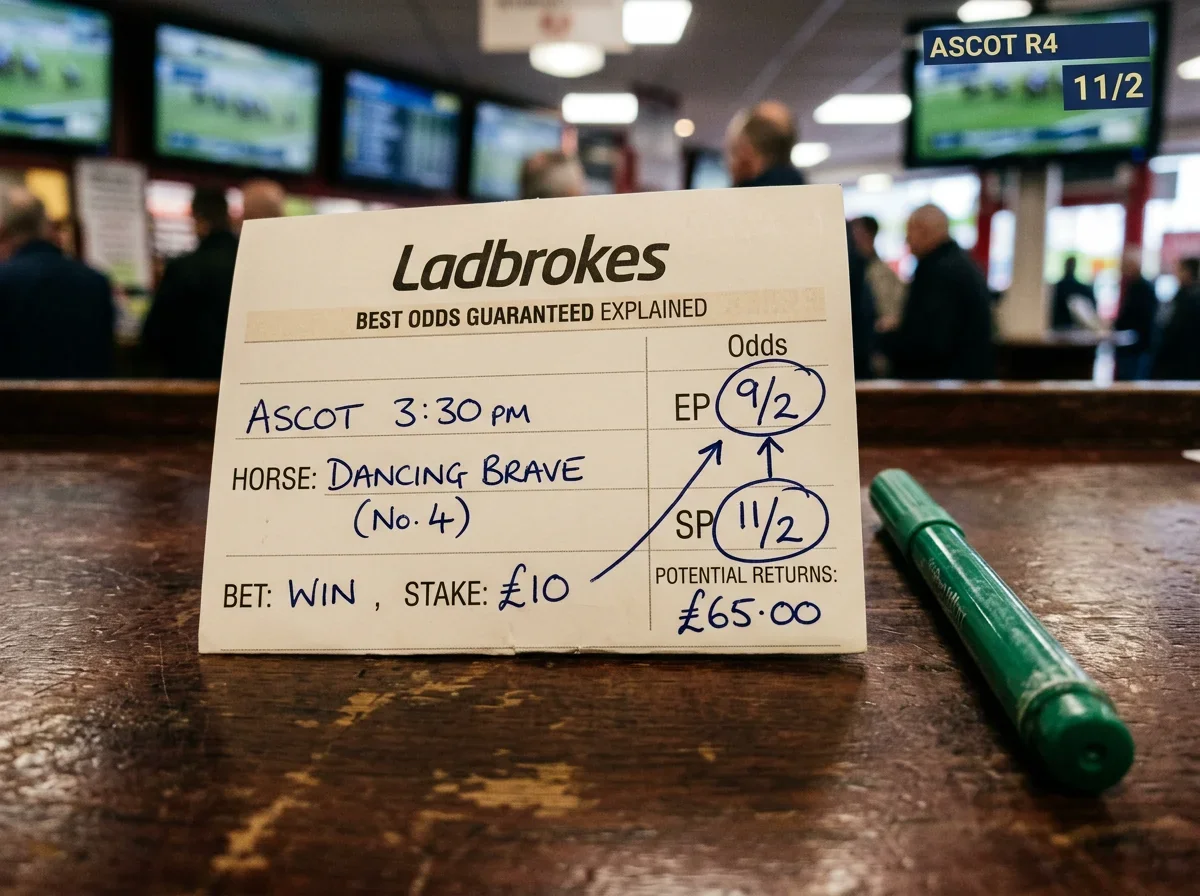
The third is using BOG-eligible legs to recapture some of the multiplied margin. Best Odds Guaranteed adds roughly 5–10% to annual profitability on winning singles by paying the better of your taken price or SP. On accumulators, BOG can apply to each leg individually at some books — meaning if any leg drifts to SP, you collect at the higher price for that leg. This is not a free lunch — most major books either exclude accumulators from BOG entirely or apply restrictions — but where it is available, it shaves enough off the compounded margin to make small-stakes accas modestly less punishing.
Festival Accumulators
Festival meetings concentrate the same dynamics into a single afternoon. The classic festival acca is four favourites across the card, or four horses with a common trainer connection, or four selections from a single trusted pundit. The marketing case is that festivals are where favourites perform — Cheltenham 2024 saw a 33% favourite strike rate across the four days, and the headline events frequently see well-fancied horses winning.
The maths does not change at the festival. A four-fold of festival favourites at average individual odds of 5/2 (decimal 3.5) carries the same compounded probability calculation as anywhere else — roughly 7% chance of all four landing, returning around 14.0 (13/1) before BOG considerations. A £20 stake on a 13/1 four-fold pays £280. The implied probability of around 7% means you would expect to win this bet roughly one Saturday in fourteen, and across a year of similar bets you would lose 13 of those Saturdays in exchange for one £280 win — net expectation of around –£20 across the cycle, or a 7% negative ROI per attempt.
That is the festival acca in its raw maths. The reason it persists as a popular Saturday bet is not that it is a good bet. It is that the structure aligns with how casual punters experience the festival — multiple races, multiple opinions, one combined ticket — and the rare big wins are emotionally outsized relative to their frequency.
One layer that does shift the festival acca maths meaningfully is bookmaker bonuses on multi-leg bets. Several UK books offer enhanced acca bonuses on festival cards — 5% extra on five-folds, 10% on six-folds, sometimes more. These bonuses do not fully offset the compounded margin, but they reduce the drag enough that a high-conviction festival acca can land in the range of “reasonable entertainment spend” rather than “bad bet”. For a fuller discussion of how multi-structure bets can be sized for low-conviction selections, see the Lucky 15 structure and where its bonuses justify the stake outlay.
The Honest Place of the Acca
Accumulators are not evil and they are not stupid. They are high-variance entertainment with a structural negative expected value that scales with the number of legs. Used at small stakes, with full awareness of what the maths actually says, they can be part of a balanced approach to Saturday racing — the equivalent of a lottery ticket for a Saturday card.
Read our detailed review of Affordability Checks for UK Horse Racing Punters: What Actually Happens.
What they are not, and what no amount of marketing can make them, is a way for a small bankroll to become a big one through skill. Skill in accumulator betting amounts to one thing — limiting yourself to two- and three-leg structures on high-conviction selections, and treating anything longer as entertainment spending rather than serious punting. The Saturday acca culture is harmless if framed that way and corrosive if not. The honest punter knows which version they are running on any given Saturday, and adjusts accordingly.
How does the overround compound in an acca?
Bookmaker margin on each individual race typically runs 5% on the top of the market, with the full-field overround often 15–25%. When you accumulate, the margins multiply rather than add. A two-leg acca compounds to roughly 10% combined margin, a four-fold to roughly 22%, a six-fold to roughly 35%, an eight-fold to roughly 50%. The longer the acca, the more of your stake the bookmaker has built into their margin before the first race runs. This is why expected value on long accas is decisively negative even when individual selections look fairly priced — the structural drag dominates the maths.
Can BOG be applied to each leg of an acca?
It depends on the book. Several major UK operators apply BOG to individual legs within accumulators on UK and Irish racing — meaning each leg pays at the better of your taken price or the SP. Others exclude accumulators from BOG entirely. Where it is available, it shaves a meaningful slice off the compounded margin, but it is not a workaround for the underlying maths. Check the specific terms on your accounts — the small print varies considerably and has tightened across 2025–2026 as operators have responded to broader margin pressure.
Created by the ”Best bet in Horse Racing” editorial team.