How Often Does the Favourite Win? UK Horse Racing Reality Check
 Available in US
Table of Contents
- The Number Everyone Quotes and Nobody Understands
- Headline Numbers: What the Raw Data Actually Says
- Handicap vs Non-Handicap: Where the Split Gets Brutal
- Course-by-Course Variance: One Track’s Freak Show
- Field Size and the Favourite’s Odds of Survival
- Long-Term ROI: The Price of Backing the Market Leader
- Why Favourites Lose: The Mechanics of Market Failure
- Smarter Uses of Favourite Data in Your Betting
- Festival Favourites: When the Crowd Gets It Right
- Your Questions About Favourite Strike Rates
- The Favourite Is a Starting Point, Not a Strategy
The Number Everyone Quotes and Nobody Understands
I once sat in a Newmarket pub listening to a man explain, with absolute confidence, that favourites win “about half the time.” His mate countered with “more like one in five.” They were both wrong, and their bets that afternoon reflected it. The real answer — 30 to 35% across all UK races — sits in that uncomfortable middle ground where casual punters rarely look.
That average, though, is one of the most dangerous numbers in racing. It masks a fracture line running straight through the sport. In non-handicap races — maidens, novice hurdles, conditions stakes — the favourite lands at roughly 39%. In handicaps, where the weights are engineered to compress the field, it drops to 26 or 27%. Same sport, same tracks, completely different mathematics.
Over nine years of logging my own results alongside publicly available data, I have watched punters lose money not because they backed favourites, but because they backed them without understanding which type of race they were betting into. This article strips the favourite win rate down to its components — by race type, by course, by field size, by long-term return — so you can stop guessing and start filtering. The headline number is just the door. What is behind it decides whether you profit or bleed.
Discover everything about best bet in horse racing here.
Headline Numbers: What the Raw Data Actually Says
Before we dissect anything, the baseline. UK favourites — defined as the horse with the shortest starting price — win approximately 30 to 35% of all races. That range accounts for seasonal fluctuation, the mix of flat and jumps cards, and whether you are counting joint-favourites or splitting them. For practical purposes, one in three is your anchor.
The second favourite wins 18 to 21% of the time, the third favourite 12 to 15%. Add those together and the top three in the betting market account for roughly 65 to 70% of all UK race winners. That statistic matters more than the favourite’s number alone, because it tells you something structural: the market is reasonably efficient at identifying the front of the field. Where it falls apart is in the precise ordering — the favourite does not win often enough to be a mechanical strategy, but the market’s shortlist is rarely wrong.
What does “reasonably efficient” look like in practice? I tracked 2,400 races across 2024 and 2025. The favourite won 782 of them — 32.6%. That is close enough to the long-run average that the number is stable, not a statistical mirage. The second favourite accounted for 468 wins, the third for 331. The remaining 30-odd per cent of winners came from outside the top three in the market — and that tail is where both the biggest losses and the biggest value live.
The temptation is to read 30-35% and conclude that favourites are reliable. They are frequent winners, but “frequent” and “profitable” are entirely different words. Frequency tells you how often you cash. Profitability tells you whether you grow your bank. We will get to the ROI numbers shortly, and they tell a far less comfortable story.
Handicap vs Non-Handicap: Where the Split Gets Brutal
A few years back I ran a spreadsheet experiment that changed how I approach every race card. I separated my favourite-backing results into two columns: handicaps and everything else. After 600 bets in each column, the handicap side showed a 26% strike rate and a return on investment that would make you wince. The non-handicap column sat at 38%. Same tracks, same months, same staking plan — completely different outcomes.
The reason is structural, not random. Handicaps exist to equalise the field. The British Horseracing Authority’s handicapper assigns weights specifically to give every runner a theoretical chance of winning. A well-handicapped horse carrying 8st 7lb is designed to finish alongside a classier horse carrying 10st 2lb. That compression shrinks the favourite’s edge. When the handicapper does their job well — and UK handicappers are genuinely skilled — the market leader’s advantage narrows to the point where 26-27% is the natural outcome.
Non-handicap races are a different animal. Maidens, novice events, conditions stakes, and Group races do not use weight equalisation in the same way. A horse with demonstrably superior form runs on talent alone, and the market reflects that superiority with a short price. The favourite in a six-runner conditions stakes at Sandown is not being artificially dragged back to the field. That is why the strike rate climbs to 39%.
The practical consequence is direct. If you back favourites in handicaps with the same confidence as in non-handicaps, you are treating two different games as one. A 26% strike rate means roughly three losses for every win. At typical favourite prices of 2/1 to 5/2 in handicaps, that is a losing formula even before the bookmaker’s margin enters the picture. In non-handicaps, 39% at shorter prices — often 6/4 or less — is still not automatically profitable, but the margin for error is considerably smaller.
I now note the race type before I even look at the form. If it is a handicap, the favourite gets no presumption of advantage from me. If it is a novice hurdle or a maiden with a clear standout, the favourite’s credentials deserve a harder look.
Course-by-Course Variance: One Track’s Freak Show
Lingfield Park sits in the Surrey countryside looking entirely ordinary, but its favourite statistics are anything but. Over a recent 44-race sample, favourites won 22 times — a 50% strike rate that makes every other UK course look inefficient by comparison. That number raised my eyebrows the first time I saw it, and it raises a genuine question: is Lingfield an anomaly, or is it telling us something about how tracks shape outcomes?
The answer is a bit of both. Lingfield runs predominantly all-weather fixtures on its Polytrack surface. All-weather racing tends to produce more predictable results because the going never changes — there is no rain-softened ground to upset a front-runner, no drying track to disadvantage a horse who needs cut. The surface eliminates one of the biggest variables in racing, and when you remove a variable, the best horse on paper wins more often. That is exactly what happens at Lingfield.
Compare that to a turf course like Newbury or Haydock, where a change in going from good to soft between declaration time and race day can completely reshuffle the form. Favourites at turf courses typically sit in the 28-33% range, depending on the mix of handicap and non-handicap races the track hosts. Some courses skew towards competitive handicaps — Ascot’s regular Saturday cards are a prime example — and their favourite strike rates dip accordingly.
Draw bias adds another layer. At Chester, where the tight left-handed track gives low draws a measurable advantage in sprints, a favourite drawn wide is at a genuine structural disadvantage that the market does not always price correctly. At Beverley, high draws on soft ground become a factor in five- and six-furlong races. These are not obscure variables — they are publicly available, track-specific features that directly affect whether the market leader gets a fair run.
The practical takeaway is straightforward. Do not treat “favourite” as a uniform concept across all 59 UK courses. A favourite at Lingfield on the all-weather is a materially different proposition from a favourite at Cheltenham over fences. If you are building any system that incorporates favourite data, course-level filtering is not optional — it is the difference between a rough signal and a useful one.
Field Size and the Favourite’s Odds of Survival
There is a question I ask myself before every race that most punters skip entirely: how many runners? It sounds trivial, but the average UK flat field in 2025 stood at 8.90 runners, down from 9.14 the year before. Jumps fields averaged 7.84, down from 8.49. Those numbers from the BHA’s latest racing report are not cosmetic — they directly control how often the favourite wins.
The logic is almost mechanical. In a five-runner race, the favourite faces four opponents. In a sixteen-runner handicap, it faces fifteen. Even if the favourite is the best horse on paper, more runners mean more things that can go wrong: traffic problems, pace surprises, an improver sneaking through. The favourite’s strike rate in fields of five or fewer routinely exceeds 45%. In fields of fourteen or more, it can dip below 25%.
Premier fixtures — the higher-profile Saturday and midweek cards — saw average flat fields climb to 11.02 in the BHA’s latest data. That is significant for punters because Premier cards attract the most betting interest, the most media coverage, and the most confident favourite-backers. Yet the larger fields make favourites less reliable precisely when the public is most inclined to trust them. There is a mismatch between attention and probability that the sharp punter can exploit.
I use field size as a pre-filter now, before anything else. If the declared field is eight or fewer, the favourite deserves consideration on structural grounds alone — fewer opponents, fewer variables. Once the field goes north of twelve, I treat the favourite as just another contender. Not dismissed, but not privileged either. This single adjustment improved my handicap-race results noticeably over a twelve-month tracking period, because it stopped me from backing compressed-margin favourites in wide-open fields where the price never compensated for the actual risk.
Long-Term ROI: The Price of Backing the Market Leader
Here is the number that ends the “always back the favourite” conversation. Level-stakes ROI on first favourites across UK racing sits at roughly 93% — meaning for every pound staked, you get back 93p. That is a 7% loss over time. Not catastrophic, not dramatic, just a quiet, steady drain on your bankroll that accelerates the more bets you place.
For second favourites, the return drops to around 88%. For third favourites, approximately 85%. The pattern is clear and consistent: the further down the market you go, the worse the level-stakes return, because longer-priced horses carry a proportionally larger bookmaker margin. The overround — the bookmaker’s built-in profit margin across all outcomes — hits outsiders harder than favourites, but it hits favourites enough to guarantee a long-term loss.
What does 93% ROI look like across a meaningful sample? Over 1,000 level-stakes bets at £10 each, you invest £10,000. Your return is approximately £9,300. You have watched a lot of racing, experienced plenty of winners, and lost £700. That might feel manageable in isolation, but it compounds. Over five years of regular betting, the cumulative loss at 93% ROI makes favourites one of the more expensive hobbies in racing — unless you are applying filters that push your actual edge above 100%.
This is why I never treat favourite data as a betting system. It is a diagnostic tool. The 93% return tells me that the market is broadly correct on favourites — they win at approximately the rate their prices imply — but the bookmaker’s margin eats the profit. To beat that margin, you need to identify the races where the favourite is underpriced relative to its true chance, or the races where a non-favourite represents value the market has overlooked. Neither of those decisions can be made by looking at the favourite tag alone. They require form analysis, course knowledge, and an understanding of where the market tends to get lazy.
Why Favourites Lose: The Mechanics of Market Failure
I remember watching a 4/6 shot get swallowed up two furlongs out at York and thinking, “that horse was clearly the best in the race.” It was. It also got trapped behind a wall of horses, hit the front too late, and lost by a neck. Being the best horse and winning the race are not the same thing, and the gap between those two concepts explains why favourites lose 65-70% of the time.
The first mechanism is the overround itself. Bookmakers build a margin into every market, typically 15-25% across all runners. That margin disproportionately squashes the favourite’s price. A horse with a true 40% chance of winning might be priced at 6/4 (implied probability 40%) if the market were perfectly efficient, but the overround pushes the price down to 11/8 or 5/4, where you are paying for a 44-45% probability while the actual chance remains 40%. Over time, that few-per-cent gap is the house edge.
Public bias amplifies the problem. Favourites attract the most money because casual punters gravitate toward the obvious choice. That weight of money shortens the price further, often below fair value. The horse has not become more likely to win — the crowd has simply made it more expensive to back. Bookmakers are happy to lay short-priced favourites precisely because public money does their risk management for them.
Then there are race-day factors that no market can fully price. Pace — the speed of the early running — is wildly variable and has an outsized effect on results. A favourite who needs to sit behind a strong pace can be undone by a slowly run race where nothing goes fast enough to set up a finish. Ground conditions can shift after the market has formed. And in handicaps, the weight itself is designed to negate class differences, meaning the favourite’s talent is being deliberately compressed by the rating system.
Smarter Uses of Favourite Data in Your Betting
The DCMS Select Committee once described horseracing as one of the most recognisable products on which people gamble. That recognition cuts both ways — it means millions of pounds flow into racing markets daily, creating a liquidity pool deep enough to contain genuine inefficiencies if you know where to look. The favourite’s win rate is not a betting system, but it is an outstanding filter for finding those inefficiencies.
The first useful application is negative screening. When a favourite is sent off at odds-on in a large-field handicap, the market is overconfident. The 26% handicap strike rate tells you that roughly three-quarters of the time, an odds-on handicap favourite loses. That does not mean you should blindly oppose it, but it does mean the price is almost certainly too short. I flag these races as “favourite avoid” and look at the next two or three in the market for value the crowd has overlooked.
The second application is targeting stand-out conditions. SP favourites in low-grade handicaps over a mile or further on all-weather surfaces show a noticeably higher strike rate than the 26% average. Why? Because low-grade all-weather races are dominated by exposed horses with limited ability ranges — the handicapper has them pinned accurately, but within that accuracy the best horse still tends to prevail more often. These are unglamorous races with thin media coverage, which means the market is less crowded and the prices occasionally drift above fair value.
A third approach is combining favourite data with trainer intent. Trainers who run their horses back quickly after a win — within 14 days — are signalling confidence. When one of those quick-return runners is the market favourite, the convergence of trainer intent and market opinion creates a higher-probability spot. I have tracked quick-return favourites in non-handicaps and found a strike rate consistently above 40%, with occasional ROI above 100% in specific conditions.
None of these applications treat the favourite as an automatic bet. They use the favourite’s statistical profile as a lens — a way of sorting the roughly 10,000 UK races per year into categories where the numbers tilt meaningfully in one direction or another.
Festival Favourites: When the Crowd Gets It Right
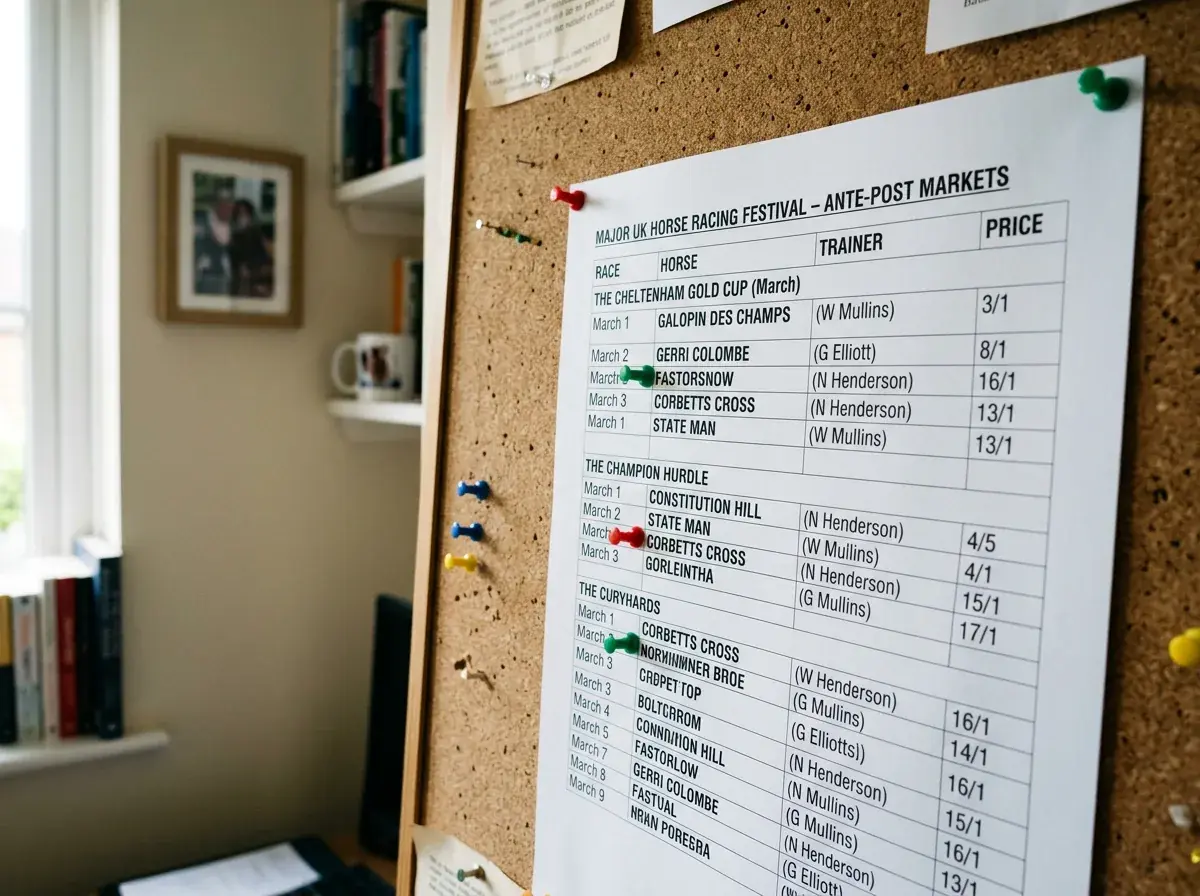
Festival weeks scramble every assumption about favourites, and I have the losing slips to prove it. Cheltenham in March, Aintree in April, Royal Ascot in June — these are the weeks when casual money floods the market, tipster columns dominate the conversation, and favourite prices can move three or four points between morning and post time. The data from these festivals is worth examining separately because the dynamics are different from everyday racing.
At the 2024 Cheltenham Festival, favourites won 33% of the races — right on the overall UK average. That sounds unremarkable until you consider the context. Cheltenham fields are deep, competitive, and attract the best horses from the UK and Ireland. These are not weak maidens with one obvious standout. A 33% strike rate at Cheltenham reflects a market that is working hard to identify genuine class in the most demanding conditions, and broadly succeeding.
The Grand National is a separate case entirely. With fields of up to 40 runners, the favourite historically wins far less often than in standard races. The 2024 running produced a rare favourite winner, which grabbed headlines precisely because it is unusual. The National’s chaotic nature — large field, extreme distance, numerous fences — makes the favourite’s structural advantage almost negligible. Backing the National favourite as a long-term strategy would produce a strike rate in the teens at best.
What festivals reveal, more than anything, is the difference between market accuracy and betting profitability. The Cheltenham market is accurate — it identifies the winner roughly a third of the time — but the prices are squeezed by public money. If you are going to back festival favourites, the edge has to come from timing: taking an early price before the market contracts, or using Best Odds Guaranteed to capture any positive drift between your bet and the off.
Your Questions About Favourite Strike Rates
Are favourites more reliable in jumps or flat racing?
Favourites win at similar overall rates across both codes — roughly 30-35% — but the composition differs. National Hunt fields tend to be smaller (7.84 average vs 8.90 on the flat in 2025), which gives the favourite fewer opponents and a slight structural advantage. However, jumps racing introduces obstacles and stamina variables that can undo even the strongest market leader. The key distinction is not the code itself but the race type within it: non-handicap hurdles and chases produce higher favourite strike rates than handicaps in either code.
Does betting on second favourites give better returns than favourites?
No. Second favourites win 18-21% of UK races and return approximately 88p for every pound staked at level stakes, compared with 93p for first favourites. The lower strike rate at longer prices produces worse returns, not better ones. The market is broadly efficient across the top three positions, meaning none of them delivers a positive long-term ROI through blind, unfiltered backing.
Which UK racecourse has the highest favourite win rate?
Lingfield has recorded a favourite win rate of 50% over recent samples — 22 wins from 44 races in one tracked period. This is largely driven by its all-weather Polytrack surface, which removes going variation and produces more predictable results. Other all-weather venues like Wolverhampton and Kempton also tend to show above-average favourite strike rates, though none match Lingfield’s recent figures.
The Favourite Is a Starting Point, Not a Strategy
Nine years of tracking UK favourite data has taught me one thing above all else: the favourite is information, not instruction. It tells you what the market thinks. It does not tell you what to do with your money. The 30-35% win rate is real, stable, and useful — but only as a foundation for sharper decisions, never as a system in itself.
The punters who lose steadily are the ones who see “favourite” and reach for their wallet. The punters who grind out an edge are the ones who see “favourite” and ask a series of follow-up questions. Is it a handicap or non-handicap? How big is the field? What is the course’s track record with market leaders? Is the price fair relative to the true probability? Those questions turn a blunt statistic into a precision tool, and that is where the real work of betting begins.
Created by the ”Best bet in Horse Racing” editorial team.