Lucky 15 Betting Explained: Combinations, Bonuses and UK Strategy
 Available in US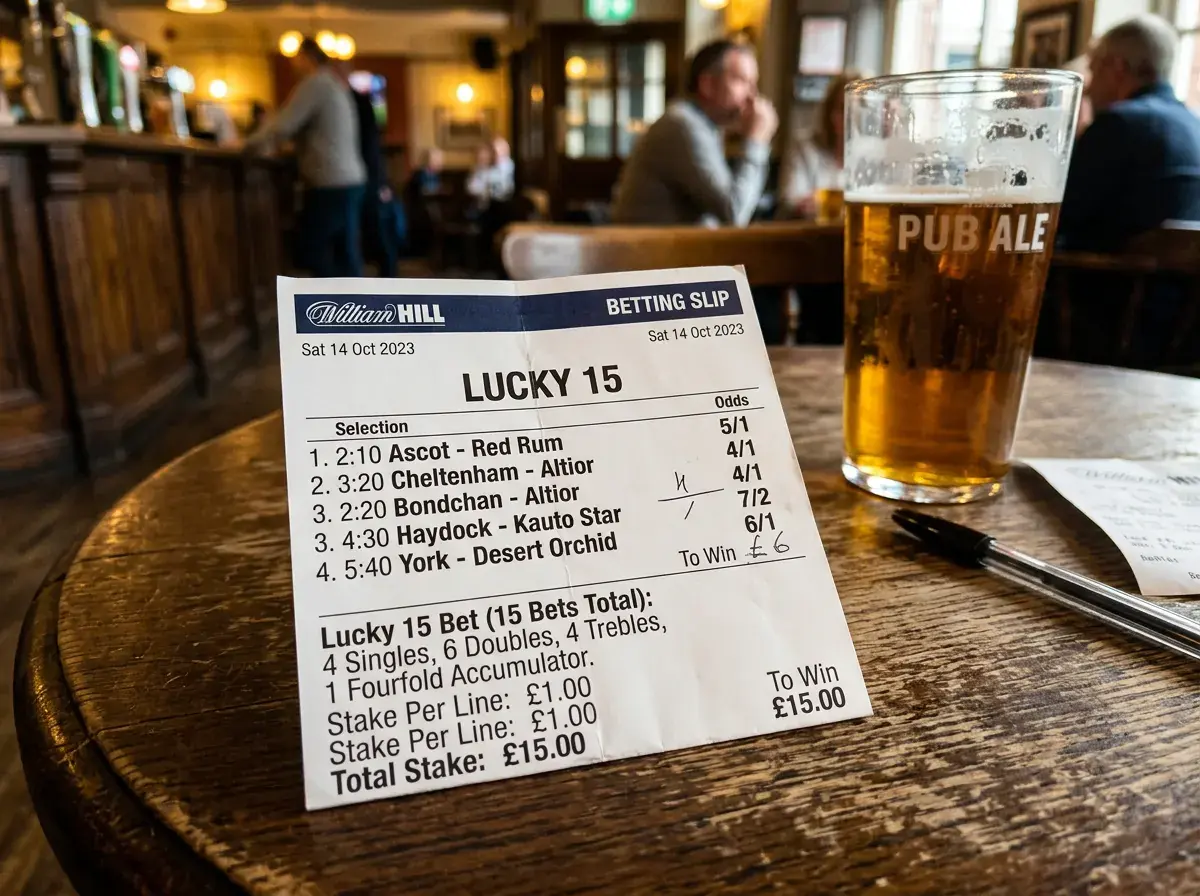
The Bet That Pays You Just for Showing Up
The Lucky 15 lived on every betting shop wall I walked past in the 2000s, advertised with hand-drawn signs and the promise of “treble the odds for one winner”. I avoided it for years because I assumed anything that combinatorial had to be a trap. When I finally did the maths properly — somewhere around 2018, after a long Wednesday at Brighton — I realised it was less of a trap than I thought and more of a niche tool that works in a narrow set of circumstances.
A Lucky 15 is fifteen bets built from four selections. Four singles, six doubles, four trebles, one four-fold. The “best bet” framing for a Lucky 15 is not about which four horses you pick — it is about how the structure rescues a low-conviction set of picks where a regular accumulator would die on the first leg. The bonuses on top change the maths in ways most punters never bother to check.
Find the best options for best bet in horse racing.
The Fifteen Bets Inside the Single Slip
Take four selections — call them A, B, C and D. The Lucky 15 breaks them down as follows. Four singles: A, B, C, D. Six doubles, which is every two-way combination of the four: AB, AC, AD, BC, BD, CD. Four trebles, which is every three-way combination: ABC, ABD, ACD, BCD. One four-fold accumulator: ABCD.
Add them up: 4 + 6 + 4 + 1 = 15. That is the structure, and it is unchangeable. The combinatorial maths is fixed — you cannot have a Lucky 15 with a different breakdown. What changes is the stake per line and the bookmaker bonuses attached to particular outcomes.
The key insight is that even with one winner from your four selections, you still collect on at least one bet — the single on the winning horse. With two winners, you collect on two singles, one double, and the relevant elements light up across the structure. With three winners, you collect on three singles, three doubles, one treble. With four winners, every line wins.
This is what makes the Lucky 15 different from a four-fold accumulator. A four-fold needs all four to win to pay anything. A Lucky 15 starts paying with one winner. The trade-off is the cost: you are placing fifteen bets instead of one, so the total stake is fifteen times your per-line stake. A £1-per-line Lucky 15 costs £15 total. A £2-per-line costs £30. The per-line stake is multiplied by fifteen, and the fifteen lines collectively need to recover that cost before any profit is generated.
What the Stake Actually Costs and Pays
The honest maths of a Lucky 15. Imagine four selections at average decimal price of 4.0 (3/1). A £1-per-line Lucky 15 costs £15. If exactly one of your four wins — let us say A — you collect on the single A only. Return: £4 (your £1 stake plus £3 winnings at 3/1). Net outcome on the bet: –£11. You have lost most of your stake despite getting one out of four right.
If two win — say A and B — you collect singles A and B, plus double AB. Singles: £4 + £4 = £8. Double AB at 4.0 × 4.0 = 16.0 returns £16 on £1 staked. Total return: £24 on £15 outlay. Profit: £9.
If three win — A, B, C — singles A, B, C return £12. Doubles AB, AC, BC each return £16 = £48. Treble ABC at 4.0 × 4.0 × 4.0 = 64.0 returns £64. Total: £124 on £15 outlay. Profit: £109.
If all four win, every line returns. Singles £16, doubles £96, trebles £256, four-fold £256 = £624. Net profit: £609 on £15 outlay.
These numbers explain why the Lucky 15 is sometimes called a “punter’s structure”: you start needing roughly two winners from four to break even, and three or four winners generate disproportionate returns. The break-even threshold depends on the prices, but two winners at average 4.0 is roughly where the Lucky 15 starts paying meaningfully. UK favourites win 30–35% of races, and the second favourites win 18–21% — meaning four well-chosen selections from the top end of UK markets should produce two or more winners more often than naive odds calculations suggest.
The Bookmaker Bonuses That Tilt the Maths
The Lucky 15 is one of the few bet types where bookmaker bonuses materially shift the expected value. There are three standard bonuses across UK books, though the specifics vary considerably.
“Treble the odds for one winner” — if exactly one of your four selections wins, the single is paid at three times the normal price. This is the headline bonus. On a 3/1 winner, instead of collecting £4, you collect £4 × 3 = £12 (or some books frame this as the winning leg paid at three times the original odds, which works out roughly equivalent depending on the formula used). The bonus exists because the bookmaker recognises that a Lucky 15 with only one winner is otherwise a clear loser, and the bonus is what makes the bet structurally attractive to casual punters.
“Double the odds for all winners” — if all four of your selections win, the entire bet is paid at double the standard accumulated return. On a winning four-fold at combined odds of 256.0, the standard return on a £1 stake would be £256; with the bonus, £512. This caps the upside of a Lucky 15 at roughly double what the same selections would return on a straight four-fold — which is why some punters argue that a straight four-fold is better when conviction is high. The honest answer is that they are different bets for different conviction levels, and neither dominates universally.
Less common bonuses include “10% extra for any winner” or “50% bonus on three winners”. These are book-specific promotional add-ons that come and go. The discipline rule: never place a Lucky 15 without confirming the bonus structure attached to it on the specific book you are using. The bonus is what makes the bet’s maths work; without it, the Lucky 15 is just an expensive way of placing four singles and eleven multis at compounded overround.
Lucky 31 and Lucky 63: The Bigger Cousins
The Lucky 31 takes five selections and produces 31 bets — five singles, ten doubles, ten trebles, five four-folds, one five-fold. The Lucky 63 takes six selections and produces 63 bets across all combinations from singles to a six-fold.
The maths gets brutal at this scale. A £1-per-line Lucky 63 costs £63, and the bet needs three or four winners minimum to recover the outlay even at decent prices. The bonus structures scale up — typically “four times the odds for one winner” or “five times for one winner” — but the increased stake and the brutal compounding of overround across higher-leg accumulators within the structure make the expected value worse, not better, than the Lucky 15.
The use case for the bigger structures is narrow. They make sense when you have five or six selections at long prices — say 6/1 and longer — where two winners alone would produce a meaningful return because the doubles pay so well. They make no sense at short prices, where the structural drag of placing 31 or 63 individual bets at compounded margin overwhelms the bonus value.
My own use of the bigger structures is essentially nil. The Lucky 15 has a genuine niche; the Lucky 31 and Lucky 63 are usually casino-class entertainment dressed in betting clothes.
When the Lucky 15 Works as a Real Bet
The Lucky 15 earns its place in the toolkit in two specific situations.
The first is a card with four selections of similar middling conviction. You like four horses across the day at prices in the 5/2 to 6/1 range. You do not have a single nap. The straight singles approach commits four units of stake across four bets, with the variance unmanaged. The four-fold accumulator commits one unit on the all-or-nothing outcome. The Lucky 15 commits fifteen units of stake across a structure that pays incrementally as winners come in. For middling-conviction four-horse sets, the Lucky 15 sits in a useful middle ground between singles and the four-fold.
The second is festival cards where the bookmaker bonuses are most generous. Many UK books boost Lucky 15 bonuses at the Cheltenham Festival, Royal Ascot and the Grand National meeting. The “treble the odds for one winner” sometimes becomes “five times the odds”, and the all-winners bonus can scale similarly. These promotions are the bookmaker’s acquisition tool for casual festival punters, and the punter who reads the small print captures real value from them — meaningfully more than the same selections would produce as singles, and considerably more than as a straight four-fold.
One sister bet structure worth understanding alongside the Lucky 15 is ante-post markets, where the price advantage of betting early offsets some of the compounded-margin drag that hurts multis. The full case is in ante-post betting and the trade-off between non-runner risk and bigger prices — relevant here because Lucky 15s built on ante-post selections combine the bonus structure with longer prices, and the maths can land in genuinely positive territory for the punter who picks the festival winners early.
The Bet at Its Best and Its Worst
At its best, the Lucky 15 is a tool for capturing the value of middling-conviction four-horse sets, particularly at festival meetings where the bonus structure is generous. At its worst, it is an expensive way of placing fifteen losing bets when none of your four selections wins — which happens often enough that anyone betting Lucky 15s blindly will run out of bankroll before the variance evens out.
Read our detailed review of Odds Comparison Tools for UK Horse Racing: Squeezing Every Tick.
The discipline. Use the Lucky 15 when you have four genuine selections you would back as singles at smaller stakes anyway, when the bookmaker bonus is verified and meaningful, and when your bankroll can absorb the fifteen-unit outlay without breaching your normal staking rules. Skip it when you have one or two strong picks and two filler selections, when the bonus structure is unclear, or when the cost of fifteen units exceeds 5% of your bankroll. Inside those rules, it works. Outside them, it is the same long-term losing structure as any other casual multi-bet — just dressed up in better marketing.
Do all UK bookmakers offer Lucky 15 bonuses?
Most established UK books offer some version of the standard bonuses — typically treble odds for one winner and a percentage bonus for all winners — but the specific terms vary significantly and have tightened over the last two years. Some books cap the bonus value, others restrict it to particular race types or exclude festival meetings from the standard promotion. Always check the bonus terms on the specific book before placing the bet, because a Lucky 15 without the bonuses is structurally a losing bet, and the bonus is what makes the maths work in the punter’s favour.
Can you place a Lucky 15 each-way?
Yes, and at most UK books this is an option directly on the bet slip. An each-way Lucky 15 is effectively two Lucky 15 structures running in parallel — one on the win element and one on the place element, with the place portion paid at the standard each-way fraction. The total stake doubles, because you are placing 30 underlying bets across the combined structure. This is a useful approach on cards with long-priced selections where the place portion alone may cover the outlay, but it requires careful attention to the maths because the per-line stake commitment is twice what a straight Lucky 15 costs.
Written by the editors at Best bet in Horse Racing.